


Booster Pump Installation: What to Keep in Mind Before Investing in a Pressure Booster Pump
Whether you wonder why water pressure drops in homes, or a commercial space owner dealing with patchy, fluctuating water pressure in restrooms, or an architect who knows about the common signs of low water pressure, you have to keep in mind a few things before making an investment in a pressure booster pump.
Here is a comprehensive pre-installation guide and the most important things you should consider before installing a pressure booster pump.
01. Where is your water coming from?
Is it coming from an overhead tank? Or an underground sump? Is the availability consistent? A booster pump works best when the water supply can be checked for availability & regularity. For commercial properties or multi-storey homes/buildings this check is even more critical because water demands will vary widely through the day.

02. What is your usage?
The few main points you must know are:
-
Number of bathrooms
-
Number & type of fixtures (appliances, rain showers, high-flow mixers, body jets etc.)
-
Total head height in homes & multi-storey buildings
-
Peak demands for water–especially important for architects to must design layouts accordingly
-
How many fixtures will run simultaneously–a commercial space (hotel / gym etc) owner should have an idea of this because it will impact the size / capacity of the pump

03. Plumbing system compatibility & Layout
If you are considering a booster pump in an existing building, it would be good to inspect your plumbing system thoroughly by an expert. What you should know includes:
-
What’s the material of pipes– Galvanised Iron (GI) / Polyvinyl Chloride (PVC / Chlorinated Polyvinyl Chloride (CPVC). Each of these pipes have a specific property and a booster pump should be installed accordingly. For instance, PVC cannot handle excessively high pressure.
-
Size of pipes
-
What’s the quality of all fittings & joints
-
Are pipelines rated for pressure?
Quite often, old / weak pipes leak or give way when subjected to higher pressure of water flow. It is also advisable to ensure that hot water pipelines are not connected to the booster pump’s inlet unless the system is designed accordingly. The booster pump should handle only cold water. However, this is information that is best provided by a certified technician / plumber.
It is also good to assess the physical site for space availability so a booster pump can be fitted easily.
04. Electrical requirements
Safe installation of the booster pump, which is an electrical device, is hugely important. While a certified electrician is the best person for this job, it is good for you to know the following as well:
-
What is the operating voltage? It should be 180–240 V
-
Power rating
-
Is there a dedicated power point? 6A for up to 1 hp, and 16A for 1.5 & 2.0 hp
-
Correct & sturdy earthing
-
Safe wiring
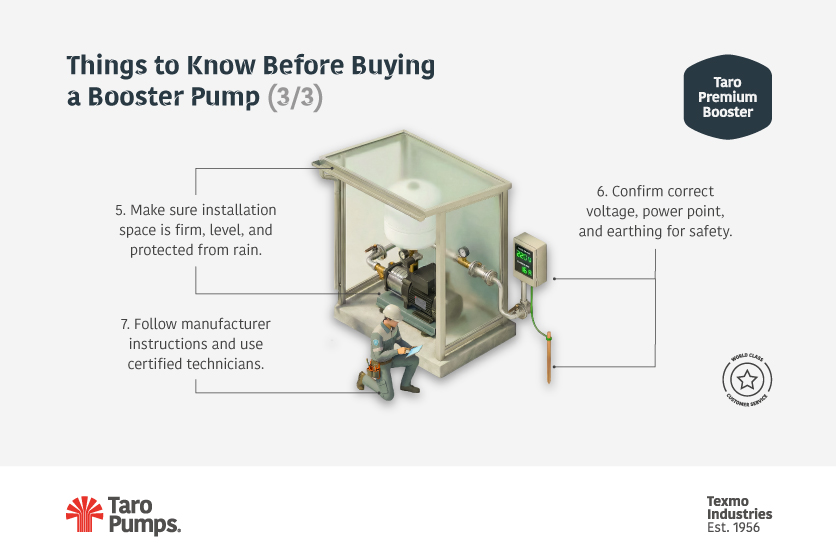
Finally, & perhaps most importantly, professional installation is mandatory. Choose a manufacturer who has a wide network of authorised dealers, certified technicians, and high-quality booster pumps. This will ensure that your site is inspected by someone who knows what they are doing before installing a booster pump.
A booster pump is a long-term investment. When you get the pre-installation checks right, then you get reliable, consistent, and luxurious water pressure every single day.